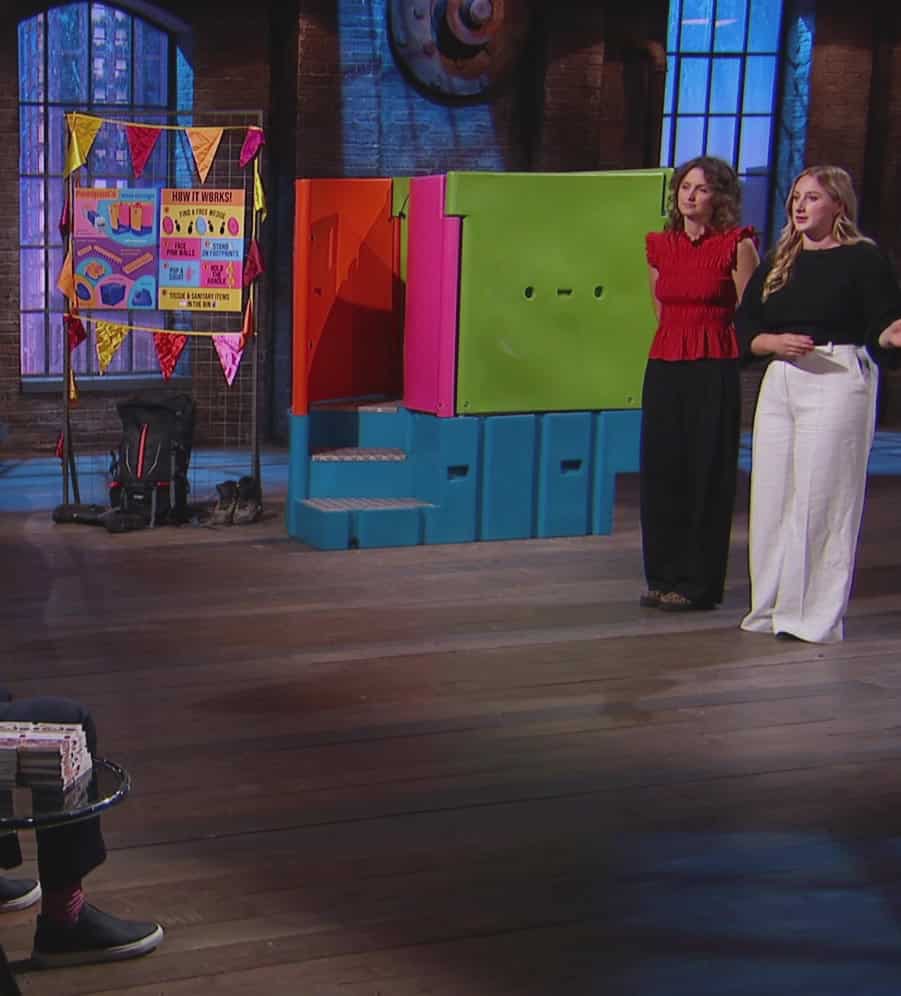
Taking to the TEDxBristol Stage, PEEQUAL present: No, You Hold It. Why Women Still Queue to Pee.
PEEQUAL took to the TEDxBristol stage to explore gender equality, toilet queues, and why better design can give women their time back.

From a festival toilet queue to the TEDxBristol stage
Festivals, marathons, and live events have one thing in common for women: a long toilet queue. That ‘quick’ toilet break can turn into a twenty-minute wait, a missed set, or the decision to hold it in longer. For PEEQUAL’s co-founders, Amber Probyn and Hazel McShane, this familiar experience became the starting point for a much bigger question: why are women still waiting?
On the TEDxBristol stage, Amber and Hazel dive into the history and inequality behind the public toilet queues, and how their own experiences at festivals and events led them to create PEEQUAL, the UK’s first squat-and-go women’s urinal.
Watch Amber and Hazel’s TEDxBristol talk below:
Sharing with the TEDx audience, Hazel & Amber exposed:
- Why women face longer toilet queues at festivals and events.
- How public toilets have historically been shaped around men’s needs.
- How they turned their own experiences into a so-loo-tion for minimising women’s toilet queues.
- How PEEQUAL is helping women spend less time waiting and more time enjoying the event they paid for.
- Why better toilet design gives women freedom, liberation, and control.
- The public inequality hidden in a toilet queue
Toilet queues are often treated as an inevitable part of going to a festival or large event. The queues are something to joke about, complain about with friends, and accept as part of the experience. Amber and Hazel’s talk asks us to look at the queue differently.
Women can wait up to 34x longer than men to use the toilet at festivals. This isn’t just an inconvenience, it has a direct impact on how women experience events and public spaces. It can mean missing your favourite act, losing friends, or deciding to dehydrate to avoid the wait.
Women have become so accustomed to this experience that we rarely stop to question why it happens. What looks like a queue can actually be a measure of whose time, health, and dignity we value in society.
The ‘Loo Leash’: when access to toilets affects freedom
The history of public sanitation and infrastructure goes a little way to understanding the origin of longer toilet queues for women. There’s just not enough provision.
The earliest known male urinals date back to ninth century Sri Lanka. Centuries later, Paris introduced public standing urinals that allowed men to relieve themselves easily while out and about. In the UK, the 1875 Public Health Act helped build more public toilets, but provision was overwhelmingly designed around men.
The logic for this design was simple: men moved through cities, while women stayed at home.
Society has changed dramatically since then, but infrastructure hasn’t always kept up. Decisions about who needed access to public toilets made then, are still shaping who can comfortably move through and participate in life now.
Amber and Hazel described this as the ‘Loo Leash’, which is the idea that your independence is only as far as your access to a loo. Without suitable facilities, our ability to work, travel, attend events, and stay out longer can be restricted. When you scale this up to large scale events, mass participation sports and festivals, the problem is only exacerbated.
Understanding the problem, designing a bespoke solution?
While Amber and Hazel were studying for their Masters in Innovation at the University of Bristol, they set out to find a solution. Beginning with sketches and cardboard mock-ups of a women’s urinal, they took to the fields to gather user feedback, insights and opinions at 5 different events in 2021, including Shambala, Valley Fest and The Bristol Comedy Garden.
One finding stood out: 80% of women they spoke to said they hovered.
This shaped PEEQUAL’s design philosophy. Rather than adapting a traditional toilet, they focused on what women said they needed; prioritising hygiene, efficiency, and ease while maintaining privacy and dignity.
From cardboard prototypes to Glastonbury Festival
Turning the idea into a working product brought challenges, from tank capacity to servicing and event logistics. Amber and Hazel worked with festival and event organisers to solve these practicalities.
At Glastonbury Festival in 2022, Hazel & Amber launched PEEQUAL and have since taken their women’s urinals to more than 55 different events, including TCS London Marathon, Brighton Pride, The Boat Race, Reading and Leeds Festival, Download, Shambala, and Boardmasters.
Over 1.25 million women have used PEEQUAL since its launch. And for many the response is the same: “This is a gamechanger! Why has no one done this before?”
So, why hasn’t it been done before?
Taboo. Women needing to pee has historically been treated as impolite or embarrassing to discuss. The problem of women’s toilet queues becomes normalised, expected, making it easy to overlook. PEEQUAL is helping make that problem visible enough to question.
Because toilets aren’t simply toilets. They are infrastructure that affects freedom.
Toilets are about time, comfort, and freedom
The impact of toilet provision is clearer when we stop thinking about the toilet itself and start thinking about what happens around it.
A long toilet queue can mean missing half an act, or drinking less because you don’t want to queue again. Access to a toilet can therefore affect how much time we have, how comfortable we feel, and how much control we have over our own experience.
The same principles apply beyond festivals, and to stadiums, parks, marathons, workplaces, and other public spaces where people need access to toilets with dignity, fast!
Ready to improve the toilet experience at your event?
Want to find out how PEEQUAL can improve the toilet experience at your event? Discover how PEEQUAL works or get in touch with the PEEQUAL team.